The production of concrete blocks consists of four basic processes: mixing, molding, curing, and cubing. Some manufacturing plants produce only concrete blocks, while others may produce a wide variety of precast concrete products including blocks, flat paver stones, and decorative landscaping pieces such as lawn edging. Some plants are capable of producing 2,000 or more blocks per hour.
The following steps are commonly used to manufacture concrete blocks.
Mixing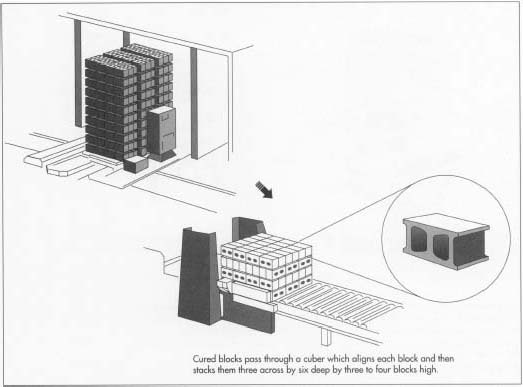
bucket conveyor and transported to an elevated hopper. The mixing cycle begins again for the next load.
10 The kiln is an enclosed room with the capacity to hold several racks of blocks at a time. There are two basic types of curing kilns. The most common type is a low-pressure steam kiln. In this type, the blocks are held in the kiln for one to three hours at room temperature to allow them to harden slightly. Steam is then gradually introduced to raise the temperature at a controlled rate of not more than 60°F per hour (16°C per hour). Standard weight blocks are usually cured at a temperature of 150-165°F (66-74°C), while lightweight blocks are cured at 170-185°F (77-85°C). When the curing temperature has been reached, the steam is shut off, and the blocks are allowed to soak in the hot, moist air for 12-18 hours. After soaking, the blocks are dried by exhausting the moist air and further raising the temperature in the kiln. The whole curing cycle takes about 24 hours.
Another type of kiln is the high-pressure steam kiln, sometimes called an autoclave. In this type, the temperature is raised to 300-375°F (149-191°C), and the pressure is raised to 80-185 psi (5.5-12.8 bar). The blocks are allowed to soak for five to 10 hours. The pressure is then rapidly vented, which causes the blocks to quickly release their trapped moisture. The autoclave curing process requires more energy and a more expensive kiln, but it can produce blocks in less time.
The manufacture of concrete blocks requires constant monitoring to produce blocks that have the required properties. The raw materials are weighed electronically before they are placed in the mixer. The trapped water content in the sand and gravel may be measured with ultrasonic sensors, and the amount of water to be added to the mix is automatically adjusted to compensate. In areas with harsh temperature extremes, the water may pass through a chiller or heater before it is used.
As the blocks emerge from the block machine, their height may be checked with laser beam sensors. In the curing kiln, the temperatures, pressures, and cycle times are all controlled and recorded automatically to ensure that the blocks are cured properly, in order to achieve their required strength.
The FutureThe simple concrete block will continue to evolve as architects and block manufacturers develop new shapes and sizes. These new blocks promise to make building construction faster and less expensive, as well as result in structures that are more durable and energy efficient. Some of the possible block designs for the future include the biaxial block, which has cavities running horizontally as well as vertically to allow access for Plumbing and electrical conduits; the stacked siding block, which consists of three sections that form both interior and exterior walls; and the heatsoak block, which stores heat to cool the interior rooms in summer and heat them in winter. These designs have been incorporated into a prototype house, called Lifestyle 2000, which is the result of a cooperative effort between the National Association of Home Builders and the National Concrete Masonry Association.
Copyright © 2026 eLLeNow.com All Rights Reserved.