Capitalism is an economic systembased on the private ownership of capital goods and the means of production, with the creation of goods and services for profit.[1][2]Elements central to capitalism include capital accumulation, competitive markets, and a price system.[3]
There are multiple variants of capitalism, including laissez-faire, welfare capitalism, and state capitalism. Capitalism is considered to have been applied in a variety of historical cases, varying in time, geography, politics, and culture.[4]There is general agreement that capitalism became dominant in the Western worldfollowing the demise of feudalism.[5]
Economists (including political economists) and historians have taken different perspectives on the analysis of capitalism. Economists usually emphasize the degree to which government does not have control over markets (laissez-faire), as well as the importance of property rights.[6][7]Most political economists emphasize private property as well, in addition to power relations, wage labor, class, and the uniqueness of capitalism as a historical formation.[8]The extent to which different markets are free, as well as the rules defining private property, is a matter of politics and policy. Many states have what are termed mixed economies, referring to the varying degree of planned and market-drivenelements in an economic system.[8]
In the 20th century defenders of the capitalist system often replaced the terms capitalism with phrases such as free enterprise and private enterprise and capitalistwith investor or rentier in reaction to the negative connotations sometimes associated with capitalism.[9]
The term capitalism, in its modern sense, comes from the writings of Karl Marx.[4][10]
There are a number of different elements in the capitalist socio-economic system.
Capitalism is defined as a social and economic system where capital assets are mainly owned and controlled by private persons, where labor is purchased for money wages, capital gains accrue to private owners, and the price mechanism is utilized to allocate capital goods between uses. The extent to which the price mechanism is used, the degree of competitiveness, and government intervention in markets distinguish exact forms of capitalism.[11]
There are different variations of capitalism which have different relationships to markets and the state. In free-market and Laissez-faireforms of capitalism, markets are utilized most extensively with minimal or no regulation over the pricing mechanism. In interventionistand mixed economies, markets continue to play a dominant role but are regulated to some extent by government in order to correct market failures, promote social welfare, conserve Natural Resources, and fund defense and public safety. In state capitalist systems, markets are relied upon the least, with the state relying heavily on state-owned enterprises or indirect economic planning to accumulate capital.
Capitalism and capitalist economics is generally considered to be the opposite of socialism, which contrasts with all forms of capitalism in the following ways: social ownership of the means of production, where returns on the means of production accrue to society at large, and goods and services are produced directly for their utility (as opposed to being produced by profit-seeking businesses).
[edit] Factors of productionA product is any good produced for exchange on a market. A commodity refers to any good exchanged in a market, but more recently refers solely to standard products such as raw materials.
There are two types of products:
The three inputs required for production are:
Capitalism entails the private ownership of the latter two — natural resources and capital goods — by a class of owners called capitalists, either individually, collectively or through a state apparatus that operates to maximize profits or that serves the interests of capital owners.
[edit] Money, capital, and accumulationMoney was primarily a standardized medium of exchange, and final means of payment, that serves to measure the value of all goods and commodities in a standard of value. It is an abstraction of economic value and medium of exchange that eliminates the cumbersome system of barter by separating the transactions involved in the exchange of products, thus greatly facilitating specialization and trade through encouraging the exchange of commodities. Capitalism involves the further abstraction of money into other exchangeable assets and the accumulation of money through ownership, exchange, interest and various other financial instruments.
Capital in this sense refers to money used to buy something only in order to sell it again to realize a financial profit.
The accumulation of capital refers to the process of "making money", or growing an initial sum of money through investment in production. Capitalism is based around the accumulation of capital, whereby financial capital is invested in order to realize a profit and then reinvested into further production in a continuous process of accumulation. In Marxian economic theory, this dynamic is called the law of value.
[edit] Capital and financial marketsThe defining feature of capitalist markets, in contrast to markets and exchange in pre-capitalist societies like feudalism, is the existence of a market for capital goods (the means of production), meaning exchange-relations (business relationships) exist within the production process. Additionally, capitalism features a market for labor. This distinguishes the capitalist market from pre-capitalist societies which generally only contained market exchange for final goods and secondary goods. The "market" in capitalism refers to capital marketsand financial markets.
Capitalism is the system of raising, conserving and spending a set monetary value in a specified market. There are three main markets in a basic capitalistic economy: labor, goods and services, and financial. Labor markets (people) make products and get paid for work by the goods and services market (companies, firms, or corporations, etc.) which then sells the products back to the laborers. However, both of the first two markets pay into and receive benefits from the financial market, which handles and regulates the actual money in the economic system. This includes banks, credit-unions, stock exchanges, etc. From a monetary standpoint, governments control just how much money is in circulation worldwide, which can play a role on how money is spent in one's own country.
[edit] Wage labor and class structureWage labor refers to the class-structure of capitalism, whereby workers receive either a wage or a salary, and owners receive the profitsgenerated by the factors of production employed in the production of economic value. Individuals who possess and supply financial capital to productive ventures become owners, either jointly (as shareholders) or individually. In Marxian economics these owners of the means of production and suppliers of capital are generally called capitalists. The description of the role of the capitalist has shifted, first referring to a useless intermediary between producers to an employer of producers, and eventually came to refer to owners of the means of production.[9]The term capitalist is not generally used by supporters of mainstream economics.
"Workers" includes those who expend both manual and mental (or creative) labor in production, where production does not simply mean physical production but refers to the production of both tangible and intangibleeconomic value. "Capitalists" are individuals who derive income from investments.
Labor includes all physical and mental human resources, including entrepreneurial capacity and management skills, which are needed to produce products and services. Production is the act of making products or services by applying labor power to the means of production.[12][13]
[edit] MacroeconomicsMacroeconomics keeps its eyes on things such as inflation: the rate at which money loses its value over time; growth: how much money a government has and how quickly it accrues money; unemployment, and rates of trade between other countries. Whereas microeconomics deals with individual firms, people, and other institutions that work within a set frame work of rules to balance prices and the workings of a singular government.
Both micro and macroeconomics work together to form a single set of evolving rules and regulations. Governments (the macroeconomic side) set both national and international regulations that keep track of prices and corporations' (microeconomics) growth rates, set prices, and trade, while the corporations influence what federal laws are set.[14][15][16]
[edit] Types of capitalismThere are many variants of capitalism in existence that differ according to country and region. They vary in their institutional makeup and by their economic policies. The common features among all the different forms of capitalism is that they are based on the production of goods and services for profit, predominately market-based allocation of resources, and they are structured upon the accumulation of capital. The major forms of capitalism are listed below:
[edit] MercantilismMain articles: Mercantilism and ProtectionismMercantilism is a nationalist form of early capitalism that came into existence approximately in the late 16th century. It is characterized by the intertwining of national business interests to state-interest and imperialism, and consequently, the state apparatus is utilized to advance national business interests abroad. An example of this is colonists living in America who were only allowed to trade with and purchase goods from their respective mother countries (Britain, France, etc.). Mercantilism holds that the wealth of a nation is increased through a positive balance of trade with other nations, and corresponds to the phase of capitalist development called the Primitive accumulation of capital.
[edit] Free-market capitalismSee also: Free marketand Laissez-faireFree-market capitalism refers to an economic system where prices for goods and services are set freely by the forces of supply and demand and are allowed to reach their point of equilibrium without intervention by government policy. It typically entails support for highly-competitive markets, private ownership of productive enterprises. Laissez-faire is a more extensive form of free-market capitalism where the role of the state is limited to protecting property rights.
[edit] Social-market economyMain articles: Social market and Nordic modelA social-market economy is a nominally free-market system where government intervention in price formation is kept to a minimum but the state provides significant services in the area of social security, unemployment benefits and recognition of labor rightsthrough national collective bargaining arrangements. This model is prominent in Western and Northern European countries, albeit in slightly different configurations. The vast majority of enterprises are privately-owned in this economic model.
Rhine capitalism refers to the contemporary model of capitalism and adaptation of the social market model that exists in continental Western Europe today.
[edit] State capitalismMain article: State capitalismState capitalism consists of state ownership of the means of production within a state, and the organization of state enterprises as commercial, profit-seeking businesses. The debate between proponents of private versus state capitalism is centered around questions of managerial efficacy, productive efficiency, and fair distribution of wealth.
According to Aldo Musacchio, a professor at Harvard Business School, it is a system in which governments, whether democratic or autocratic, exercise a widespread influence on the economy, through either direct ownership or various subsidies. Musacchio also emphasizes the difference between today's state capitalism and its predecessors. Gone are the days when governments appointed bureaucrats to run companies. The world's largest state-owned enterprises are traded on the public markets and kept in good health by large institutional investors.[17]
[edit] Corporate capitalismMain article: Corporate capitalism See also: State monopoly capitalismand Crony capitalismCorporate capitalism is a free or mixed-market economy characterized by the dominance of hierarchical, bureaucratic corporations. State-monopoly capitalism was originally a Marxist concept referring to a form of corporate capitalism in which state policy is utilized to benefit and promote the interests of dominant or established corporations by shielding them from competitive pressures or by providing them with subsidies.[citation needed]
[edit] Mixed economyMain article: Mixed economy See also: Economic interventionismA mixed economy is a largely market-based economy consisting of both private and public ownership of the means of production and economic interventionism through macroeconomic policies intended to correct market failures, reduce unemployment and keep inflation low. The degree of intervention in markets varies among different countries. Some mixed economies, such as France under dirigisme, also featured a degree of indirect economic planning over a largely capitalist-based economy.
Most capitalist economies are defined as "mixed economies" to some degree.
Socialism is an economic systemcharacterised by social ownership of the means of production and co-operative management of the economy.[1]"Social ownership" may refer to cooperativeenterprises, common ownership, state ownership, or citizen ownership of equity.[2] There are many varieties of socialism and there is no single definition encapsulating all of them.[3] They differ in the type of social ownership they advocate, the degree to which they rely on markets or planning, how management is to be organised within productive institutions, and the role of the state in constructing socialism.[4]
A socialist economic system would consist of a system of production and distribution organized to directly satisfy economic demands and human needs, so that goods and services would be produced directly for use instead of for private profit[5] driven by the accumulation of capital. Accounting would be based on physical quantities, a common physical magnitude, or a direct measure of labour-time in place of financial calculation.[6][7]Distribution would be based on the principle to each according to his contribution.
As a political movement, socialism includes a diverse array of political philosophies, ranging from reformism to revolutionary socialism. Proponents of state socialismadvocate the nationalisationof the means of production, distribution and exchange as a strategy for implementing socialism. In contrast, libertarian socialism proposes the traditional view of direct worker's control of the means of production and opposes the use of state power to achieve such an arrangement, opposing both parliamentary politics and state ownership.[citation needed] Democratic socialism seeks to establish socialism through democratic processes and propagate its ideals within the context of a democratic political system.
Modern socialism originatedfrom an 18th-century intellectual and working classpolitical movement that criticised the effects of industrialisationand private property on society. In the early 19th-century, "socialism" referred to any concern for the social problems of capitalism irrespective of the solutions to those problems. However, by the late 19th-century, "socialism" had come to signify opposition to capitalism and advocacy for an alternative system based on some form of social ownership.[8]Marxists expanded further on this, attributing scientific assessmentand democratic planning as critical elements of socialism.
PhilosophyFurther information: Socialist critique of capitalismSocialists adhere to a diverse range of philosophical views. Marxian socialism is philosophically materialist as well as having at its centre a commitment to historical materialism. Many forms of socialist theory hold that human behaviour is largely shaped by the social environment. In particular, Marxism and socialists inspired by Marxist theory, holds that social mores, values, cultural traits and economic practices are social creations, and are not the result of an immutable natural law.[10] The ultimate goal for Marxist socialists is the emancipation of labour from alienating work. Marxists argue that freeing the individual from the necessity of performing alienating work in order to receive goods would allow people to pursue their own interests and develop their own talents without being coerced into performing labour for others. For Marxists, the stage of economic development in which this is possible, sometimes called full communism, is contingent upon advances in the productive capabilities of society.
Socialists generally argue that capitalism concentrates power and wealth within a small segment of society that controls the means of production and derives its wealth through a system of exploitation. This creates a stratified society based on unequalsocial relations that fails to provide equal opportunities for every individual to maximise their potential,[11] and does not utilise available technology and resources to their maximum potential in the interests of the public.[12]
EconomicsSee also: Socialist economicsand Production for useThe original conception of socialism was an economic system whereby production was organised in a way to directly produce goods and services for their utility (or use-value in classical and Marxian economics): the direct allocation of resources in terms of physical units as opposed to financial calculation and the economic laws of capitalism (see: Law of value), often entailing the end of capitalistic economic categories such as rent, interest, profit and money.[13] In a fully developed socialist economy, production and balancing factor inputs with outputs becomes a technical process to be undertaken by engineers.[14]
Market socialism refers to an array of different economic theories and systems that utilise the market mechanism to organise production and to allocate factor inputs among socially owned enterprises, with the economic surplus (profits) accruing to society in a social dividendas opposed to private capital owners.[15]Variations of market socialism include Libertarianproposals such as mutualism, based on classical economics, and neoclassical economic models such as the Lange Model.
The ownership of the means of production can be based on direct ownership by the users of the productive property through worker cooperative; or commonly ownedby all of society with management and control delegated to those who operate/use the means of production; or public ownership by a state apparatus. Public ownership may refer to the creation of state-owned enterprises, nationalisation, municipalisationor autonomous collective institutions. The fundamental feature of a socialist economy is that publicly owned, worker-run institutions produce goods and services in at least the commanding heights of the economy.[16]
Management and control over the activities of enterprises are based on self-management and self-governance, with equal power-relations in the workplace to maximise occupational autonomy. A socialist form of organisation would eliminate controlling hierarchies so that only a hierarchy based on technical knowledge in the workplace remains. Every member would have decision-making power in the firm and would be able to participate in establishing its overall policy objectives. The policies/goals would be carried out by the technical specialists that form the coordinating hierarchy of the firm, who would establish plans or directives for the work community to accomplish these goals.[17]
The role and use of money in a hypothetical socialist economy is a contested issue. Socialists including Karl Marx, Robert Owen, Pierre-Joseph Proudhon and John Stuart Mill advocated various forms of labour vouchersor labour-credits, which like money would be used to acquire articles of consumption, but unlike money, they are unable to become capital and would not be used to allocate resources within the production process. Bolshevik revolutionary Leon Trotsky argued that, following a socialist revolution, money could not be arbitrarily abolished. Money had to exhaust its "historic mission" (continue to be used until it became redundant), and then would be transformed into bookkeeping receipts for statisticians, and only in the more distant future would it might not be required even for that role.[18]
"I am convinced there is only one way to eliminate (the) grave evils (of capitalism), namely through the establishment of a socialist economy, accompanied by an educational system which would be oriented toward social goals. In such an economy, the means of production are owned by society itself and are utilized in a planned fashion. A planned economy, which adjusts production to the needs of the community, would distribute the work to be done among all those able to work and would guarantee a livelihood to every man, woman, and child. The education of the individual, in addition to promoting his own innate abilities, would attempt to develop in him a sense of responsibility for his fellow-men in place of the glorification of power and success in our present society."
— Albert Einstein, Why Socialism?, 1949[19]
Planned economyMain article: Planned economyA planned economy is a type of economy consisting of a mixture of public ownership of the means of production and the coordination of production and distribution through economic planning. There are two major types of planning: decentralized-planning and centralized-planning. Enrico Baroneprovided a comprehensive theoretical framework for a planned socialist economy. In his model, assuming perfect computation techniques, simultaneous equations relating inputs and outputs to ratiOS of equivalence would provide appropriate valuations in order to balance supply and demand.[20]
The most prominent example of a planned economy was the economic system of the Soviet Union, and as such, the centralised-planned economic model is usually associated with the Communist states of the 20th century, where it was combined with a single-party political system. In a centrally planned economy, decisions regarding the quantity of goods and services to be produced are planned in advance by a planning agency. (See also: Analysis of Soviet-type economic planning). The economic systems of the Soviet Union and the Eastern Bloc are further classified as command economies, which are defined as systems where economic coordination is undertaken by commands, directives and production targets.[21]Studies by economists of various political persuasions on the actual functioning of the Soviet economy indicate that it was not actually a planned economy. Instead of conscious planning, the Soviet economy was based on a process whereby the plan was modified by localized agents and the original plans went largely unfulfilled. Planning agencies, ministries and enterprises all adapted and bargained with each other during the formulation of the plan as opposed to following a plan passed down from a higher authority, leading some economists to suggest that planning did not actually take place within the Soviet economy and that a better description would be an "administered" or "managed" economy.[22]
Although central planning was largely supported by Marxist Leninists, some factions within the Soviet Union before the rise of Stalinism held positions contrary to central planning. Leon Trotsky rejected central planning in favor of decentralized planning. He argued that central planners, regardless of their intellectual capacity, would be unable to coordinate effectively all economic activity within an economy because they operated without the input and tacit knowledge embodied by the participation of the millions of people who in the economy. As a result, central planners would be unable to respond to local economic conditions.[23]
Various economists and political theorists, including Richard D. Wolff and Stephen Resnick, have criticised the notion that the Soviet-style planned economies represented a type of socialist economy. This analysis highlights the fact that the Soviet economy was structured upon the accumulation of capital and the extraction of surplus value from the working class by the planning agency in order to reinvest the surplus in new production in a perpetual cycle – or to distribute to managers and senior officials in the form of bonuses, indicating the Soviet Union (and other Soviet-type economies) were in reality state capitalist economies.[24]Other socialists have focused their analyses on the lack of self-management, the continued existence of financial calculation and the existence of a bureaucratic elite based on hierarchical and centralised powers of authority in the Soviet model, leading them to conclude that the Soviet system was not socialist, instead categorising it as bureaucratic collectivism, state capitalism or deformed workers' states.
Self-managed economySee also: Decentralized planningand Workers' self-managementA self-managed, decentralised economy is based upon autonomous self-regulating economic units and a decentralised mechanism of resource allocation and decision-making. This model has found support in notable classical and neoclassical economists including Alfred Marshall, John Stuart Mill and Jaroslav Vanek. There are numerous variations of self-management, including labour-managed firms and worker-managed firms. The goals of self-management are to eliminate exploitation and reduce alienation.[25]
One such system is the cooperative economy, a largely free market economy in which workers manage the firms and democratically determine remuneration levels and labour divisions. Productive resources would be legally owned by the cooperative and rented to the workers, who would enjoy usufructrights.[26]Another form of decentralised planning is the use of cybernetics, or the use of computers to manage the allocation of economic inputs. The socialist-run government of Salvador Allende in Chile experimented with Project Cybersyn, a real-time information bridge between the government, state enterprises and consumers.[27]Another, more recent, variant is participatory economics, wherein the economy is planned by decentralised councils of workers and consumers. Workers would be remunerated solely according to effort and sacrifice, so that those engaged in dangerous, uncomfortable, and strenuous work would receive the highest incomes and could thereby work less.[28] A contemporary model for a self-managed, non-market socialism is Pat Devine's model of negotiated coordination. Negotiated coordination is based upon social ownership by those affected by the use of the assets involved, with decisions made by those at the most localised level of production.[29]
Michel Bauwensidentifies the emergence of the open software movement and peer-to-peer production as a new, alternative mode of production to the capitalist economy and centrally planned economy that is based on collaborative self-management, common ownership of resources, and the production of use-values through the free cooperation of producers who have access to distributed capital.[30]
Anarchist communism is a theory of anarchism which advocates the abolition of the state, private property, and capitalism in favour of common ownership of the means of production.[31][32]
The economy of the former Socialist Federal Republic of Yugoslavia established a system based on market-based allocation, social ownership of the means of production and self-management within firms. This system substituted Yugoslavia's Soviet-type central planning with a decentralized, self-managed system after reforms in 1953.[33]Another practical example of worker's self-management was syndicalism as practiced in Catalonia during the Spanish Civil War.
State-directed economySee also: State socialismState socialism can be used to classify any variety of socialist philosophies that advocates the ownership of the means of production by the state apparatus, either as a transitional stage between capitalism and socialism, or as an end-goal in itself. Typically it refers to a form of technocratic management, whereby technical specialists administer or manage economic enterprises on behalf of society (and the public interest) instead of workers' councils or workplace democracy.
A state-directed economy may refer to a type of mixed economy consisting of public ownership over large industries, as promoted by various Social democratic political parties during the 20th century. This ideology influenced the policies of the British Labour Party during Clement Attlee's administration. In the biography of the 1945 UK Labour Party Prime Minister Clement Attlee, Francis Beckett states: "the government... wanted what would become known as a mixed economy".[34]
Nationalisation in the UK was achieved through compulsory purchase of the industry (i.e. with compensation). British Aerospace was a combination of major aircraft companies British Aircraft Corporation, Hawker Siddeleyand others. British Shipbuilders was a combination of the major shipbuilding companies including Cammell Laird, Govan Shipbuilders, Swan Hunter, and Yarrow Shipbuilders; the nationalisation of the coal mines in 1947 created a coal board charged with running the coal industry commercially so as to be able to meet the interest payable on the bonds which the former mine owners' shares had been converted into.[35][36]
Market socialismMain article: Market socialismMarket socialism consists of publicly owned or cooperatively owned enterprises operating in a market economy. It is a system that utilises the market and monetary prices for the allocation and accounting of the means of production, thereby retaining the process of capital accumulation. The profit generated would be used to directly remunerate employees or finance public institutions.[37] In state-oriented forms of market socialism, in which state enterprises attempt to maximise profit, the profits can be used to fund government programs and services through a social dividend, eliminating or greatly diminishing the need for various forms of taxation that exist in capitalist systems. The neoclassical economist Léon Walrasbelieved that a socialist economy based on state ownership of land and natural resources would provide a means of public finance to make income taxes unnecessary.[38]Yugoslavia implemented a market socialist economy based on cooperatives and worker self-management.
The current economic system in China is formally referred to as a Socialist market economy with Chinese characteristics. It combines a large state sector that comprises the 'commanding heights' of the economy, which are guaranteed their public ownership status by law,[39] with a private sector mainly engaged in commodity production and light industry responsible from anywhere between 33%[40](People's Daily Online 2005) to over 70% of GDP generated in 2005.[41]Although there has been a rapid expansion of private-sector activity since the 1980s, privatisation of state assets was virtually halted and were partially reversed in 2005.[42] The current Chinese economy consists of 150 corporatisedstate-owned enterprises that report directly to China's central government.[43] By 2008, these state-owned corporations had become increasingly dynamic and generated large increases in revenue for the state,[44][45]resulting in a state-sector led recovery during the 2009 financial crises while accounting for most of China's economic growth.[46]However, the Chinese economic model is widely cited as a contemporary form of state capitalism, the major difference between Western capitalism and the Chinese model being the degree of state-ownership of shares in publicly listed corporations.
The Socialist Republic of Vietnam has adopted a similar model after the Doi Moi economic renovation, but slightly differs from the Chinese model in that the Vietnamese government retains firm control over the state sector and strategic industries, but allows for private-sector activity in commodity production.[47]
Social and Political theoryIn this context, socialism has been used to refer to a political movement, a political philosophy and a hypothetical form of society these movements aim to achieve. As a result, in a political context socialism has come to refer to the strategy (for achieving a socialist society) or policies promoted by socialist organisations and socialist political parties; all of which have no connection to socialism as a socioeconomic system.
MarxismMain articles: Marxism and Socialism (Marxism)"At a certain stage of development, the material productive forces of society come into conflict with the existing relations of production or – this merely expresses the same thing in legal terms– with the property relations within the framework of which they have operated hitherto. Then begins an era of social revolution. The changes in the economic foundation lead sooner or later to the transformation of the whole immense superstructure.“ -Karl Marx, Critique of the Gotha Program[48]
Part of a series on Marxism 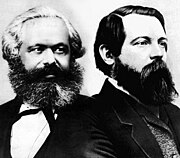 Theoretical works[show]
 Socialism portal
 Philosophy portal
 The writings of Karl Marx provided the basis for the development of Marxist political theory and Marxian economics.
 In the most influential of all economic theories on socialist thought, Karl Marx and Friedrich Engels argued that socialism would emerge out of historical necessity as capitalism rendered itself obsolete and unsustainable from increasing internal contradictions emerging from the development of the productive forces and technology. It was these advances in the productive forces combined with the old social relations of production of capitalism that would generate contradictions, leading to working-class consciousness.[49]
Marx and Engels held the view that the consciousness of those who earn a wage or salary (the working class in the broadest Marxist sense) would be moulded by their conditions of wage slavery, leading to a tendency to seek their freedom or emancipationby overthrowing ownership of the means of production by capitalists, and consequently, overthrowing the state that upheld this economic order. For Marx and Engels, conditions determine consciousness and ending the role of the capitalist class leads eventually to a classless society in which the state would wither away.
The Marxist conception of socialism is that of a specific historical phase that will displace capitalism and precede communism. The major characteristics of socialism (particularly as conceived by Marx and Engels after the Paris Commune of 1871) are that the proletariat will control the means of production through a workers' stateerected by the workers in their interests. Economic activity would still be organised through the use of incentive systems and social classes would still exist, but to a lesser and diminishing extent than under capitalism.
For orthodox Marxists, socialism is the lower stage of communism based on the principle of "from each according to his ability, to each according to his contribution" while upper stage communism is based on the principle of "from each according to his ability, to each according to his need"; the upper stage becoming possible only after the socialist stage further develops economic efficiency and the automation of production has led to a superabundance of goods and services.[50][51]
Marx argued that the material productive forces (in industry and commerce) brought into existence by capitalism predicated a cooperative society since production had become a mass social, collective activity of the working class to create commodities but with private ownership (the relations of production or property relations). This conflict between collective effort in large factories and private ownership would bring about a conscious desire in the working class to establish collective ownership commensurate with the collective efforts their daily experience.[48]
Che Guevara and Mao Zedong sought socialism based on the rural peasantry rather than the urban working class. Che Guevara attempted to inspire the peasants of Bolivia by his own example into a change of consciousness. Guevara said in 1965:
Socialism cannot exist without a change in consciousness resulting in a new fraternal attitude toward humanity, both at an individual level, within the societies where socialism is being built or has been built, and on a world scale, with regard to all peoples suffering from imperialistoppression.[52]
Evolutionary and Institutional economicsThorstein Veblen, a leading American institutionalistand evolutionary economist, argued that a subset of the working-class, the technical specialists and engineers, would become the driving force behind socioeconomic change within capitalism. There is an antagonism between industry and business, where industry refers to the process of producing goods and services and business is defined as the process of "making money". Thorstein Veblen saw socialism as an immediate stage in an ongoing evolutionary process in economics that would result from the natural decay of the system of business enterprise. In contrast to Marx, he did not believe socialism would be the result of political struggle or political revolution by the working class as a whole and did not believe it to be the ultimate goal of humanity.[53] But like Marx, Veblen saw technology as the underlying force driving social change.
Joseph Schumpeter viewed intellectuals and the intelligentsia as the group within society that would gradually move society toward socialism. Socialism would be partially a result of socio-economic evolution, the growth of workers' self-management, industrial democracy and social planning, and partially from political pressure on the part of intellectuals in Western society.[54]
Role of the stateSocialists have different perspectives on the state and its role in revolutionary struggles, constructing socialism, and within an established socialist economy.
Preceding the Bolshevik-led revolution in Russia, many socialists, including reformists, orthodox Marxist currents such as council communism and the Mensheviks, and Anarchists / Libertarian socialists criticised the idea of using the state to conduct central planning and own the means of production as a way to establish socialism.[55]
Joseph Schumpeter rejected the association of socialism and social ownership with state ownership over the means of production, because the state as it exists in its current form is a product of capitalist society and cannot be transplanted into a different institutional framework. Schumpeter argued that, just as there were different institutions within feudalism, there will be different institutions with different functions within socialism. The state, along with the concept of property and taxation, are concepts exclusive to commercial society (capitalism); placing them within the context of a future socialist society amounts to a distortion of these concepts.[56]
Utopian versus scientificMain articles: Utopian socialism and Scientific socialismUtopian socialism is a label ascribed to earlier socialists whose emphasis was on designing or imagining ideal forms of society. A utopian socialist is based on an idealist philosophy, where an ideal is envisioned and then worked towards, in contrast to Marxisms materialist methodology.
For Marxists, the development of capitalism in western Europe provided a material basis for the possibility of bringing about socialism because, according to the Communist Manifesto, "What the bourgeoisie produces above all is its own grave diggers",[57]namely the working class, which must become conscious of the historical objectives set it by society.
Reform versus revolutionMain articles: Revolutionary socialism and ReformismRevolutionary socialists believe that a social revolution is necessary to effect structural changes to the socio-economic structure of society. Among revolutionary socialists there are differences in strategy, theory and the definition of "revolution". Orthodox Maxists and Left Communists take an Impossibiliststance, believing revolution should be spontaneous as a result of contradictions in society resulting from technological changes in the productive forces. In contrast, Marxist-Leninistsand most Trotskyists advocate Vanguardism: the creation of a democratic centralist revolutionary Vanguard party led by a cadre of professional revolutionaries to overthrow the capitalist state and, eventually, the institution of the state altogether. "Revolution" is not necessarily defined by revolutionary socialists as violent insurrection,[58] but as a complete dismantling and rapid transformation of all areas of class society led by the majority of the masses: the working class.
Reformism is generally associated with social democracy and gradualist democratic socialism. Reformism is the belief that socialists should stand in parliamentary elections within capitalist society, and if elected, utilize the machinery of government to pass political and social reforms for the purposes of ameliorating the instabilities and inequities of capitalism.
PoliticsThe major socialist political movements are described below. Independent socialist theorists, [utopian socialist] authors, and academic supporters of socialism may not be represented in these movements. Some political groups have called themselves socialist while holding views that some consider antithetical to socialism. The term socialist has also been used by some politicians on the political right as an epithet against certain individuals who do not consider themselves to be socialists, and against policies that are not considered socialist by their proponents.
There are many variations of socialism and as such there is no single definition encapsulating all of socialism. However there have been common elements identified by scholars.[59]Angelo S. Rappoport in his Dictionary of Socialism (1924) analysed forty definitions of socialism to conclude that common elements of socialism include: general criticisms of the social effects of private ownership and control of capital - as being the cause of poverty, low wages, unemployment, economic and social inequality, and a lack of economic security; a general view that the solution to these problems is a form of collective control over the means of production, distributionand exchange (the degree and means of control vary amongst socialist movements); agreement that the outcome of this collective control should be a society based upon social justice, including social equality, economic protection of people, and should provide a more satisfying life for most people.[60]Bhikhu Parekh in The Concepts of Socialism (1975) identifies four core principles of socialism and particularly socialist society: sociality, social responsibility, cooperation, and planning.[61]Michael Freedenin his study Ideologies and Political Theory (1996) states that all socialists share five themes: the first is that socialism posits that society is more than a mere collection of individuals; second, that it considers human welfare a desirable objective; third, that it considers humans by nature to be active and productive; fourth, it holds the belief of human equality; and fifth, that history is progressive and will create positive change on the condition that humans work to achieve such change.[61]
AnarchismMain article: AnarchismAnarchism is often defined as a political philosophy which holds the state to be undesirable, unnecessary, or harmful.[62][63]However, others argue that while anti-statism is central, it is inadequate to define anarchism.[64]Therefore they argue, alternatively, that anarchism entails opposing authority or hierarchical organization in the conduct of human relations, including, but not only, the state system.[65][66][67][68][69][70][71]Proponents of anarchism, known as "anarchists", advocate stateless societies based on non-hierarchical[66][72][73]voluntary associations.[74][75]Mutualistsadvocate market socialism, collectivist anarchists workers cooperatives and salaries based on the amount of time contributed to production, anarcho-communistsadvocate a direct transition from capitalism to libertarian communism and a gift economy and anarcho-syndicalistsworker's direct action and the general strike.
Libertarian socialismMain article: Libertarian socialismLibertarian socialism is a non-hierarchical, non-bureaucratic, stateless society without private property in the means of production. Libertarian socialists oppose all coercive forms of social organisation, promote free association in place of government, and oppose the coercive social relations of capitalism, such as wage labor. They oppose hierarchical leadership structures, such as vanguard parties, and most are opposed to using the state to create socialism. Currents within libertarian socialism include Marxist tendencies such as left communism, council communism and autonomism, as well as non-Marxist movements such as social anarchism, Communalism, Participism, and Inclusive Democracy.
Democratic socialismMain article: Democratic socialismModern democratic socialism is a broad political movement that seeks to propagate the ideals of socialism within the context of a democratic system. Many democratic socialists support social democracy as a temporary measure to reform the current system, but others support more revolutionary tactics to establish socialism. Conversely, modern social democracy emphasises a program of gradual legislative reform of capitalism in order to make it more equitable and humane, while the theoretical end goal of building a socialist society is either completely forgotten or redefined in a pro-capitalist way. The two movements are widely similar both in terminology and in ideology, although there are a few key differences.
The major difference between social democracy and democratic socialism is the object of their politics: contemporary social democrats support a welfare state and unemployment insurance as a means to "humanize" capitalism, whereas democratic socialists seek to replace capitalism with a socialist economic system, arguing that any attempt to "humanize" capitalism through regulations and welfare policies would distort the market and create economic contradictions.[76]
Democratic socialism generally refers to any political movement that seeks to establish an economy based on economic democracy by and for the working class. Democratic socialists oppose democratic centralism and the revolutionary vanguard party of Leninism. Democratic socialism is difficult to define, and groups of scholars have radically different definitions for the term. Some definitions simply refer to all forms of socialism that follow an electoral, reformist or evolutionary path to socialism, rather than a revolutionary one.[77]
Religious socialismMain articles: Socialism and Islam and Christian socialismChristian socialism is a broad concept involving an intertwining of the Christian religion with the politics and economic theories of socialism.
Islamic socialism is a term coined by various Muslim leaders to describe a more spiritual form of socialism. Muslim socialists believe that the teachings of the Qur'an and Muhammad are compatible with principles of equality and public ownership drawing inspiration from the early Medina welfare state established by the Prophet Muhammad. Muslim Socialists are more conservative than their western contemporaries and find their roots in Anti-imperialism, anti-colonialismand Arab nationalism. Islamic Socialist leaders believe in Democracy and deriving legitimacy from public mandate as opposed to religious texts.
Buddhist Socialism is another concept that seeks to reduce unnecessary consumption and create harmony while ensuring everyone's basic needs are met.[citation needed]
Social democracyMain article: Social democracySocial democracy is not itself a socialist system. Rather, traditional social democrats advocated the creation of socialism through political reforms by operating within the existing political system of capitalism. The social democratic movement sought to elect socialists to political office to implement reforms. The modern social democratic movement has abandoned[citation needed] the goal of moving toward a socialist economy and instead advocates for social reforms to improve capitalism, such as a welfare state and unemployment benefits. It is best demonstrated by the economic format which has been used in Sweden, Denmark, Norway, and Finland in the past few decades.[78] This approach has been called the Nordic model.
In the late 20th century, the term "socialist" became used by Third Way social democrats to refer to a set of ethical ideals and values as opposed to a form of socio-economic system. It is used in this way by Anthony Giddens, who rejects conventional definitions and implementations of socialism.[9]Giddens states: "The only common characteristic of socialist doctrines is their ethical content." and says that "Socialism is the pursuit of ideas of social cooperation, universal welfare, and equality - ideas brought together by a condemnation of the evils and injustices of capitalism".[9]However Gidden's Third Way has faced condemnation by left-wing opponents, including anti-Third Way social democrats who denounce Giddens' Third Way for being anti-socialist and pro-capitalist in practice.[79]
SyndicalismMain article: SyndicalismSyndicalism is a social movement that operates through industrial trade unions and rejects state socialism and the use of establishment politics to establish or promote socialism. They reject using state power to construct a socialist society, favoring strategies such as the General strike. Syndicalists advocate a socialist economy based on federated unions or syndicates of workers who own and manage the means of production.
Some Marxist currents advocate Syndicalism, such as DeLeonism.
HistoryMain article: History of socialismThe term socialism is attributed to Pierre Leroux,[80] and to Marie Roch Louis Reybaud; and in Britain to Robert Owen in 1827, father of the cooperative movement.[81][82]Socialist models and ideas espousing common or public ownership have existed since antiquity. Mazdak, a Persian communal proto-socialist,[83]instituted communal possessions and advocated the public good. And it has been claimed, though controversially, that there were elements of socialist thought in the politics of classical Greek philosophers Plato[84] and Aristotle.[85]
The first advocates of socialism favoured social levelling in order to create a meritocratic or technocraticsociety based upon individual talent. Count Henri de Saint-Simon is regarded as the first individual to coin the term socialism.[86]Saint-Simon was fascinated by the enormous potential of science and technology and advocated a socialist society that would eliminate the disorderly aspects of capitalism and would be based upon equal opportunities.[87][unreliable source?] He advocated the creation of a society in which each person was ranked according to his or her capacities and rewarded according to his or her work.[86]The key focus of Saint-Simon's socialism was on administrative efficiency and industrialism, and a belief that science was the key to progress.[88]
 Charles Fourier, influential early French socialist thinker
 This was accompanied by a desire to implement a rationally organised economy based on planning and geared towards large-scale scientific and material progress,[86]and thus embodied a desire for a more directed or planned economy. Other early socialist thinkers, such as Thomas Hodgkin and Charles Hall, based their ideas on David Ricardo's economic theories. They reasoned that the equilibrium value of commodities approximated to prices charged by the producer when those commodities were in elastic supply, and that these producer prices corresponded to the embodied labour – the cost of the labour (essentially the wages paid) that was required to produce the commodities. The Ricardian socialists viewed profit, interest and rent as deductions from this exchange-value.[89]
West European social critics, including Robert Owen, Charles Fourier, Pierre-Joseph Proudhon, Louis Blanc, Charles Hall and Saint-Simon, were the first modern socialists who criticised the excessive poverty and inequality of the Industrial Revolution. They advocated reform, with some such as Robert Owen advocating the transformation of society to small communities without private property. Robert Owen's contribution to modern socialism was his understanding that actions and characteristics of individuals were largely determined by the social environment they were raised in and exposed to.[88]On the other hand Charles Fourieradvocated phalanstereswhich were communities that respected individual desires (including sexual preferences), affinities and creativity and saw that work has to be made enjoyable for people.[90] The ideas of Owen and Fourier were tried in practice in numerous intentional communities around Europe and the American continent in the mid-19th century.
Linguistically, the contemporary connotation of the Words socialism and communism accorded with the adherents' and opponents' cultural attitude towards religion. In Christian Europe, of the two, communism was believed the atheist way of life. In Protestant England, the Word communism was too culturally and aurally close to the Roman Catholic communion rite, hence English atheists denoted themselves socialists.[91]
Friedrich Engels argued that in 1848, at the time when the Communist Manifesto was published, "socialism was respectable on the continent, while communism was not." The Owenites in England and the Fourierists in France were considered "respectable" socialists, while working-class movements that "proclaimed the necessity of total social change" denoted themselves communists. This latter branch of socialism produced the communist work of Étienne Cabet in France and Wilhelm Weitling in Germany.[92]
EtymologyThe term "socialism" was created by Henri de Saint-Simon, a founder of utopian socialism. The term "socialism" was created to contrast against the liberal doctrine of "individualism".[93]The original socialists condemned liberal individualism as failing to address social concerns of poverty, social oppression, and gross inequality of wealth.[93]They viewed liberal individualism as degenerating society into supporting selfish egoism and that harmed community life through promoting a society based on competition.[93]They presented socialism as an alternative to liberal individualism, that advocated a society based on cooperation.[93]
First International and Second International Mikhail Bakuninspeaking to members of the IWA at the Basel Congress in 1869
 The International Workingmen's Association (IWA), also known as the First International, was founded in London in 1864. The IWA held a preliminary conference in 1865, and had its first congress at Geneva in 1866. Due to the wide variety of philosophies present in the First International, there was conflict from the start. The first objections to Marx's came from the Mutualistswho opposed communism and statism. However, shortly after Mikhail Bakuninand his followers (called Collectivistswhile in the International) joined in 1868, the First International became polarised into two camps, with Marx and Bakunin as their respective figureheads.[94] The clearest differences between the groups emerged over their proposed strategies for achieving their visions of socialism. The First International became the first major international forum for the promulgation of socialist ideas.
As the ideas of Marx and Engels took on flesh, particularly in central Europe, socialists sought to unite in an international organisation. In 1889, on the centennial of the French Revolution of 1789, the Second International was founded, with 384 delegates from 20 countries representing about 300 labour and socialist organisations.[95] It was termed the "Socialist International" and Engels was elected honorary president at the third congress in 1893. Anarchists were ejected and not allowed in mainly because of the pressure from marxists.[96]
 Jean Jaures Revolutions of 1917–1936
 Leon Trotsky, Vladimir Lenin, and Lev Kamenev at the Second Communist Party Congress, 1919.
 “ If Socialism can only be realized when the intellectual development of all the people permits it, then we shall not see Socialism for at least five hundred years. ”
— Vladimir Lenin, November 1917[97]
By 1917, the patriotism of World War I changed into political radicalismin most of Europe, the United States, and Australia. In February 1917, revolution exploded in Russia. Workers, soldiers and peasants established soviets(councils), the monarchy fell, and a provisional government convoked pending the election of a constituent assembly.
In April of that year, Vladimir Leninarrived in Russia from Switzerland, calling for "All power to the soviets." In October, after his party, the Bolsheviks, had seized power in an October Revolution it won support of most soviets at the second All-Russian Congress of Soviets. As a matter of political pragmatism, Lenin reversed Marx's order of economics over politics, allowing for a political revolution led by a vanguard party of professional revolutionaries rather than a spontaneous establishment of socialist institutions led by a spontaneous uprising of the working class as predicted by Karl Marx.[98] On 25 January 1918, at the Petrograd Soviet, Lenin declared "Long live the world socialist revolution!"[99] He proposed an immediate armistice on all fronts, and transferred the land of the landed proprietors, the
Copyright © 2026 eLLeNow.com All Rights Reserved.